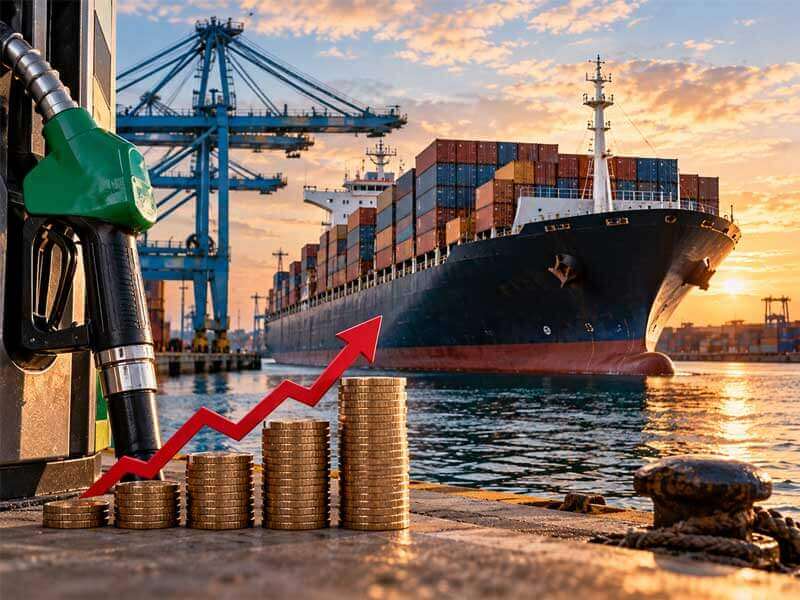
The bunker adjustment factor (BAF) is a surcharge assessed by shipping carriers to compensate for fluctuating fuel prices. Carriers commonly assess BAF based on container size, equipment type, and shipping route. Charges may be quoted per twenty-foot equivalent unit (TEU) or as a specific amount per container. The exact amount of a BAF can vary based on marine fuel prices, shipping routes, the size and type of freight, and carrier pricing policies.
Shipping lines charge BAF surcharges to offset the volatile and unpredictable cost of marine fuel, also called bunker fuel, without having to adjust their base freight rates. There is no government agency or international body that sets BAF prices. Instead, individual shipping lines use formulas to set their own BAF.
When bunker fuel prices increase, ocean carriers try to recover the additional costs using BAF and other related fuel surcharges. This will raise the overall cost to ship a container. The route a shipment takes can affect the final cost. Longer routes require more fuel, while fuel availability and prices differ across locations.
BAF and other fuel-related surcharges will decrease when the prices decrease. However, the change in freight costs might not occur immediately.
Since shipping lines are responsible for calculating their own BAF, the formulas they use can vary. Fortunately, certain formulas have been shared by different shipping lines in an effort to promote transparency.
Common formulas include:
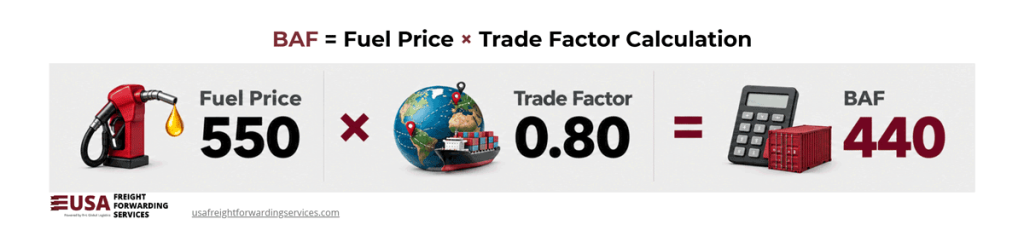
To show these formulas in action, we’ll go over some example calculations. Let’s start with the first one that multiplies fuel price and trade factor.
If marine fuel costs $550 per metric ton and the carrier assigns a trade factor of 0.80 to a particular trade lane, the BAF would be $440. We’ve provided a table that illustrates this calculation.
Next, we’ll go over an example calculation using the second formula.
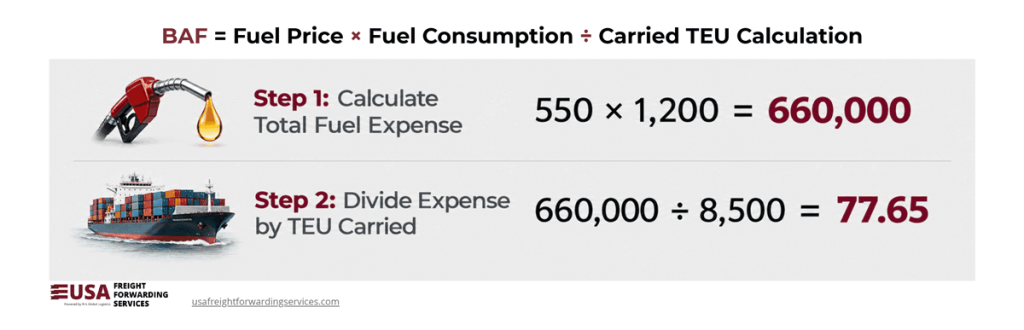
If a vessel consumes 1,200 metric tons of fuel priced at $550 per metric ton, its total fuel cost would be $660,000. If the vessel carries 8,500 TEUs, dividing the fuel expense by the number of TEUs carried results in a fuel surcharge of approximately $77.65 per TEU.
Here’s a table breaking this calculation down into two simple steps.
While these formulas are common, every carrier reserves the right to use its own method.
Ocean carriers typically update their BAF surcharges on a monthly or quarterly basis. Some carriers use defined fuel-price review periods and publish updated surcharges with future effective dates.
A BAF adjustment does not necessarily coincide with the expiration of a freight contract. Longer-term contracts may include provisions allowing fuel surcharges to change during the agreement.
Shippers should confirm the effective date of a quoted BAF and whether the surcharge can change before shipment.
The three types of BAF surcharges include:
A fixed BAF is a predefined charge that doesn’t consider changing fuel prices. It provides shippers with an accurate estimate of their shipping costs.
A flexible BAF, sometimes called a floating BAF, is a dynamic shipping surcharge that does consider changing fuel prices. While it can reflect current fuel costs, there is less certainty due to fluctuations.
A locked-in BAF is an arrangement in which the shipper and carrier agree to a price during a defined period. It serves as a compromise between continuously floating fuel surcharges and exposure to market volatility.
On January 1, 2020, the International Maritime Organization (IMO) reduced the global sulfur limit for marine fuel from 3.5% to 0.5% outside designated emission control areas, where stricter limits apply. Shipping companies can meet these requirements by using compliant low-sulfur fuel or approved alternative technologies, such as exhaust-gas cleaning systems.
Compliance can affect operating expenses because fuel choices and emission-control equipment carry different costs. Carriers may account for these expenses through BAF or other applicable fuel-related surcharges.
BAF is often confused with other terms, such as fuel surcharge, emergency bunker surcharge (EBS), and low sulfur surcharge. These terms are all distinct from BAF, which means it’s important to understand each one so you can use them correctly.
A fuel surcharge is a broad term for an additional charge used to recover fluctuations in fuel expenses. In the context of ocean freight, BAF is a specific type of surcharge shippers will have to pay.
An EBS is a temporary fee that ocean carriers charge to recover sudden, unusually large increases in marine fuel. Carriers usually charge EBS during severe geopolitical events or supply constraints. Examples include the start of the Russia/Ukraine war or disruptions in the Strait of Hormuz.
BAF and EBS differ in that BAF covers routine fluctuations in fuel price, while EBS is designed for extraordinary or sudden increases.
A low sulfur surcharge is an expense associated with using fuel that complies with sulfur-emission requirements. This surcharge is relevant due to IMO 2020 compliance. By contrast, BAF is primarily intended to account for changes in the market price of marine fuel generally.
BAF surcharges will appear on a freight quote as a separate line item, per-unit or per-container basis, percentage of the base rate, or an all-in rate.
The way a BAF surcharge appears on an ocean freight quote ultimately depends on the carrier providing it and their chosen method of calculation.
Shippers can mitigate the volatility of BAF surcharges through long-term contracts, multi-carrier benchmarking, comparing trade lanes and routing options, and improving container utilization.
Marine fuel prices fluctuate constantly, which leaves a degree of uncertainty with every shipment. Using these strategies will help secure lower and more predictable costs.
Fuel surcharges can make international shipping costs harder to predict. USA Freight Forwarding Services helps businesses compare ocean freight options, understand carrier charges, and plan international shipments.
Our freight-forwarding services cover standard container shipping, special equipment, and over-dimensional cargo.
If you’re ready to ship your ocean freight, give us a call at (866) 941-8081. You can also reach out to us on our contact page if you have additional questions.
