
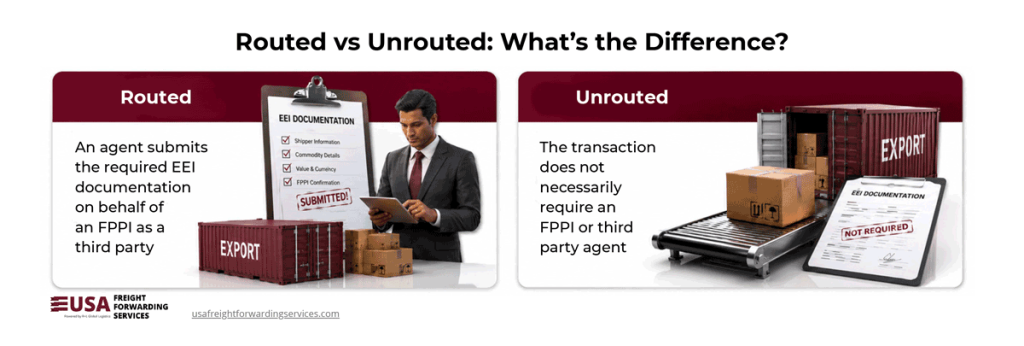
A routed export transaction, as defined in Title 15 of the Code of Federal Regulations (CFR), is an export arrangement in which a U.S. Principal Party in Interest (USPPI) authorizes a Foreign Principal Party in Interest (FPPI) to act through an authorized agent. The agent prepares and files the Electronic Export Information (EEI) and performs other export responsibilities that the FPPI is not permitted to complete on its own.
The parties involved in a routed export transaction are usually the USPPI, FPPI, and the FPPI’s designated agent. In many cases, this agent is a freight forwarder since the forwarder’s responsibilities closely align with those of an agent working for an FPPI.
The table below explains the responsibilities of each party in the transaction with greater detail.
| Party | Roles & Responsibilities |
| USPPI | Receive primary benefit of transaction (financial remuneration) Provide commodity description, Schedule B classification, and identify FPPI Maintain records of transaction per CFR regulations |
| FPPI | Controls export arrangements Provides the power of attorney (POA) to agent |
| Agent of FPPI | Receives authorization to act on behalf of an FPPI Fills out and submits EEI in the Automated Export System (AES) |
FPPIs must authorize U.S.-based agents to fulfill EEI filing requirements enforced by U.S. Customs and Border Protection (CBP), as foreign parties are not legally permitted to do so.
A transaction is considered routed when the FPPI authorizes a U.S.-based agent to prepare and file EEI on its behalf. If the agent isn’t working under the authority of an FPPI, or there is no agent involved, the transaction can be classified differently.
The USPPI is responsible for providing this information for use in the EEI filing:
USPPI Information
Commodity Information
Customs Information
It’s worth noting again that the USPPI usually provides this information to the FPPI, who then forwards it to their agent.
The freight forwarder often fulfills the role of agent for the FPPI in a routed export transaction. The forwarder coordinates logistics and submits EEI in AES using shipment details supplied through the parties involved.
This makes sense since the U.S.-based freight forwarder is uniquely positioned to provide the logistics support an FPPI needs and the qualifications to act as a third-party agent for foreign businesses.
For instance, consider a scenario in which a buyer headquartered in Japan wants to buy 10,000 units of lumber from a U.S. supplier. The buyer is now faced with a need and a roadblock:
In this scenario, the buyer contacts Freight Forwarding Services USA to inquire about freight arrangements and designating an agent to prepare the required export documents on their behalf.
By doing so, the buyer can easily make freight shipping arrangements and secure a U.S.-based agent to overcome the regulatory roadblock. The forwarder will set up international shipping while also using the information provided by the foreign party to prepare the required information in the AES.
A freight forwarder acting as an agent in a routed export transaction may make export compliance errors due to their own mistakes or incomplete/incorrect information forwarded from the USPPI.
Here are some of the most common mistakes a freight forwarder might make in such a transaction:
Depending on the severity of the error, CBP can take actions ranging from fines to seizures of goods against the offending party, regardless of whether the error was a genuine mistake or an attempt at fraud.
Routed export transactions shift EEI filing responsibility to an FPPI-authorized U.S. agent, but the USPPI still has to provide accurate shipment and classification data. If you have questions about routed export transactions or are in need of freight forwarding services, our team is standing by at (866) 941-8081 to answer your questions.
Sources:
Introduction to the Automated Export System (AES), U.S. Customs and Border Protection
Code of Federal Regulations, Title 15, Subtitle B, Chapter 1, Part 30, Subpart A, Subsection 30.3
What Every Member of the Trade Community Should Know About: Customs Administrative
Enforcement Process: Fines, Penalties, Forfeitures and Liquidated Damages, U.S. Customs and Border Protection
