
According to Title 15 of the Code of Federal Regulations (CFR), a USPPI is the party that receives the primary benefit, monetary or otherwise, of the export portion of a transaction. The seller, wholesaler, or distributor serving as the USPPI is also responsible for supplying U.S. Customs and Border Protection (CBP) with information about the exported goods, their destination, tariff classification, and the exporting business.
The seller in an export transaction is usually the USPPI, though there are some nuances to this definition.
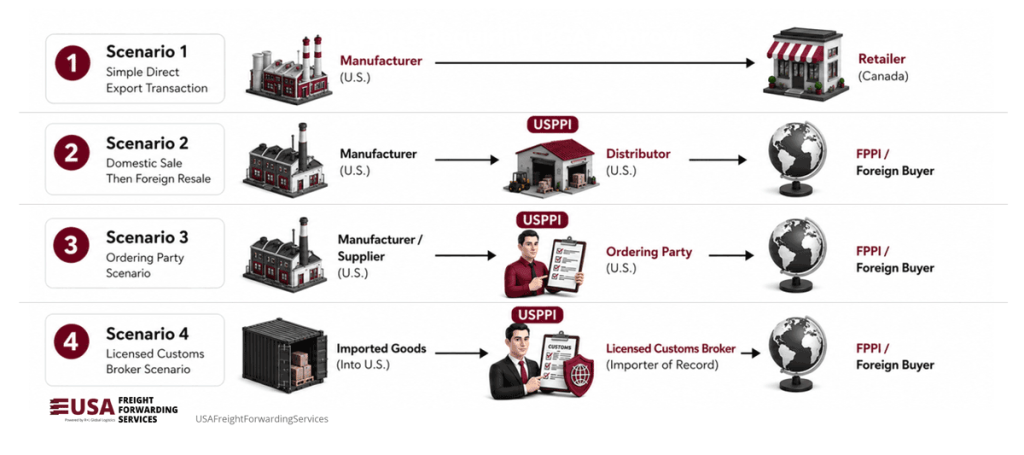
Let’s say a toy manufacturer in the U.S. sells $100,000 worth of product directly to a retailer in Canada. In this simple scenario, the manufacturer is clearly the USPPI since it received the financial benefit of the sale.
Now let’s add another party to the hypothetical transaction. The manufacturer sells the same products to a distributor, who resells them to a foreign principal party of interest (FPPI). Now the role of USPPI shifts to the distributor since the first transaction was strictly domestic.
An ordering party, as defined in Title 48 of the Code of Federal Regulations, assumes the role of USPPI when they make arrangements to sell and export goods to an FPPI.
A licensed customs broker can also be the USPPI for a transaction if:
It is less common for a freight forwarder to double as a USPPI, but it can occur under specific circumstances.
Per Title 15, U.S.-based freight forwarders don’t usually act as a USPPI in an export transaction. Since the definition of a USPPI is based on the principal parties in an export transaction (usually seller and buyer), the freight forwarder’s intermediary position doesn’t qualify.
One circumstance in which a freight forwarder doubles as the USPPI is when a foreign buyer purchases goods from multiple U.S. vendors and has a forwarder consolidate the goods into a single order, usually for administrative or bookkeeping purposes.
When I sold car parts to local mechanics, I offered a similar service on a smaller scale: purchasing specialty parts from multiple dealerships and suppliers, consolidating them into a single invoice, and marking the goods up appropriately before delivering them to the repair shop. Freight forwarders can do this on a massive, international scale, and they would be the USPPI in such transactions.
The USPPI is responsible for fulfilling CBP’s export regulations and those of any partner government agency (PGA) that has oversight on the goods being exported, such as those governed by Export Administration Regulations (EAR) and International Traffic in Arms Regulations (ITAR).
Title 15 of the CFR lists the following among a USPPI’s requirements and responsibilities:
A USPPI may designate an agent to perform these tasks on their behalf, but the principal party is still responsible for the accuracy and timeliness of the documents, and will be liable for any fines or penalties that result from non-compliance.
Non-U.S. business cannot act as the USPPI directly unless the qualifying exporting party is a U.S.-based entity, such as a domestic subsidiary.
However, a non-U.S. business can still be a USPPI if it owns subsidiaries based in the U.S. For instance, if a parent company in Italy owns a corporation based in Florida, the Floridian business can act as the USPPI on behalf of its parent company.
Understanding who the USPPI is (and what responsibilities they must perform) is fundamental knowledge for exporters in the U.S., and any confusion about those responsibilities can lead to fines, penalties, and loss of business in the future.
If you are unsure who qualifies as the USPPI in your transaction, getting the classification right before filing export documents can help prevent delays and penalties. Our team can help you review your shipping setup, identify the responsible party, and make sure your export paperwork aligns with CBP and PGA requirements.
Call us at (866) 941-8081 or submit a contact form online if you have questions about the role of a USPPI in international shipping, or if you need to make international shipping arrangements yourself.
Title 15/Subtitle B/Chapter I/Part 30/Subpart A/§30.3, Code of Federal Regulations, 2026
48 CFR § 8.401 – Definitions, Cornell Law School
Sanctions List Search, Office of Foreign Assets Control
OFAC Regulations for Exporters and Importers , Office of Foreign Assets Control, 2012
Export Administration Regulations (EAR), Bureau of Industry and Security U.S. Department of Commerce
The International Traffic in Arms Regulations (ITAR), U.S. Department of State Directorate of Defense Trade Controls
